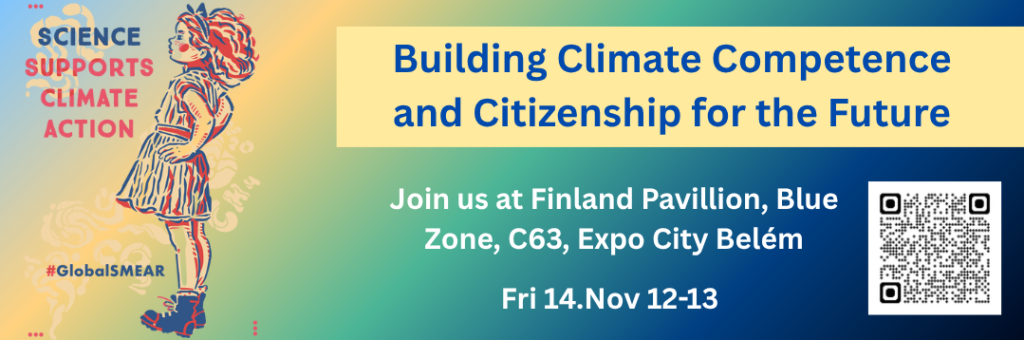
Welcome to meet us in Finland´s Pavillion 14th November at 3-4 p.m!
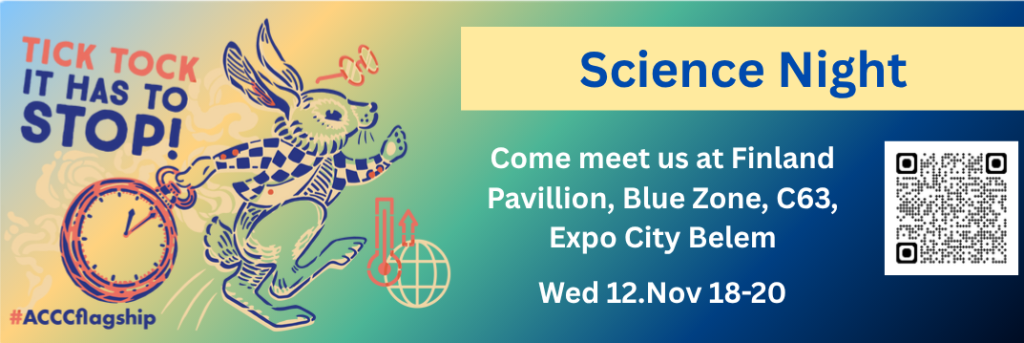
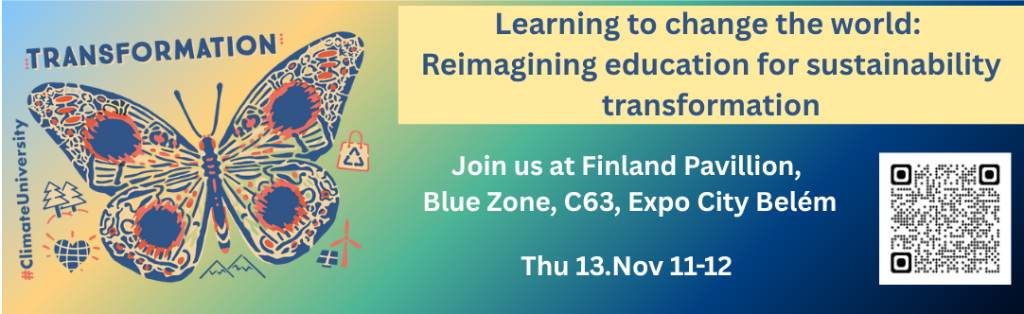
Venue: Finland Pavillion, Blue Zone, C63, Expo City Belem
How can we accelerate worldwide carbon capture and storage efforts? Join us at the world-leading Atmosphere and Climate Competence Center (ACCC) as we explore carbon capture, storage, and strive for best practices in achieving common standards, role of comprehensive measurements and climate experts educatio.
ACCC is a high-level climate research ecosystem providing latest science-based data and cooperation for public sector institutions, companies and local communities. Our aim is to strengthen global cooperation ecosystem with a variety of stakeholders and create globally scalable solutions with verifiable climate impact.
The ACCC is one of the leading entities in atmospheric research in Europe and internationally. We provide profound scientific understanding and extensive data on air quality as well as Earth surface-atmosphere interactions and feedback mechanisms, such as carbon balance across diverse environment. We are a multidiscplinary group of 800 researchers and employ cutting-edge science, technology, and big data to comprehend natural carbon sinks, emissions, and air quality. Come and listen to our message, we believe the world has a lot to learn!
COP30 ACCC event – How can we accelerate worldwide carbon capture and storage efforts? 14th November at 3-4 pm Finland Pavillion
Invited speakers and panelists
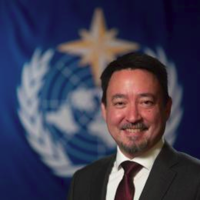
Albert Fischer
Director of WMO Integrated Global Observing System, WIGOS Branch, World Meteorological Organization.
Dr. Albert Fischer is the Director of the WMO Integrated Global Observing System Division at the World Meteorological Organization (WMO), coordinating the essential observations for weather, climate, and water intelligence. He leads the technical authority role for the Systematic Observations Financing Facility (SOFF), and in previous roles was director of the Global Ocean Observing System. His background is in physical oceanography, air-sea interaction, and interannual climate variability.
The WMO Integrated Global Observing System (WIGOS) is one of WMO’s top priorities as the new overarching framework for all WMO observing systems. Current global challenges demand a significant worldwide upgrade of space- and surface-based observations and predictions. In response, WIGOS provides a new, integrated approach incorporating the most recent scientific and technical advances. Read more: https://community.wmo.int/en/activity-areas/WIGOS
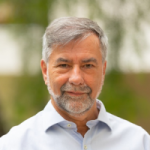
Paulo Artaxo is a professor of environmental physics at the University of São Paulo, Brazil. He is a member of the IPCC – UN Intergovernmental Panel on Climate Change. He has developed his career working with the Amazon environment and global climate change. He is a member of the Brazilian Academy of Sciences (ABC) and the World Academy of Sciences (TWAS). He is vice president of the Academy of Sciences of the State of São Paulo (ACIESP) and vice president of the Brazilian Association for the Advancement of Sciences. Paulo Artaxo has published over 500 scientific papers. He published 35 articles in the Science and Nature family of journals. He is among the most cited Brazilian scientists, with 77,000 citations on Google Scholar with an h-index of 132, as well as 61,119 scientific citations on the ResearchGate platform and an h-index of 123. He received several awards, including the TWAS Earth Science Prize, and is a fellow of the American Association for the Advancement of Science (AAAS). He also received the Doctorate Honoris Causa from the University of Stockholm, Sweden. He was included in the Clarivate Analytics list as one of the top 1% of most cited researchers worldwide in 2014, 2015, 2018, 2019, and 2020. He coordinates the Center for Studies on Amazonian Sustainability at the University of São Paulo and is a member of the Scientific Council for COP-30.
Contact: artaxo@if.usp.br
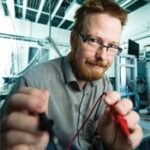
Tuukka Petäjä, Professor of Physics at the University of Helsinki. He has over 20 years of research experience related to atmospheric sciences. He is the vice-director of the Institute for Atmospheric and Earth System Research responsible for the aerosol domain and research infrastructures. His research interests span from developing measurement techniques to understanding aerosol-cloud-climate-biosphere interactions. “We measure and model atmospheric particles. We also study climate change and air quality. Maintaining and improving measurements is essential to monitor the overall picture of climate change and air quality”, says Petäjä.
Contact: tuukka.petaja@helsinki.fi, +358 50 415 5278
Scientific data and knowledge are crucial for shaping effective climate mitigation and adaptation policies – and action. Finnish atmospheric science community is known for offering novel scientific insights and comprehensive, standardized, long-term climate and ecosystem data as well as climate education on different academic levels. Represented by the Atmosphere and Climate Competence Center (ACCC), we are seeking new partnerships in both the public and private sectors at the COP30. Our aim is to further develop decarbonization and net-zero measurement methods and future measurement standards, thereby support companies in planning realistic climate goals and developing reliable and comparable sustainability reports.
We offer training to help companies and public sector entities build climate expertise. Additionally, we are at the forefront of developing innovative methods for university students to study remotely through massive online courses and virtual exchanges.
show more