
In this study, an intermediate complexity Earth system model was used to simulate the long-term deployment of two large-scale Carbon Dioxide Removal (CDR) methods. Reforestation was designed according to a global vegan dietary shift, which frees up land previously used as pasture and cropland for livestock production, allowing natural vegetation to recover. In the ocean alkalinity enhancement experiment, minerals are added to the surface ocean to increase its capacity to absorb CO2.
According to the model outputs, the two CDR methods perform differently under different levels of climate sensitivity – that is, how strongly temperature responds to cumulative emissions. Specifically, the effectiveness of reforestation decreases as climate sensitivity increases, by about 11% by 2100 and up to 33% by 2300 under very high climate sensitivity. Despite this, reforestation remains a strong mitigation option, with the potential to remove nearly 250 Gt of CO2 by 2100. On the other hand, ocean alkalinity enhancement removes CO2 consistently, regardless of climate sensitivity.
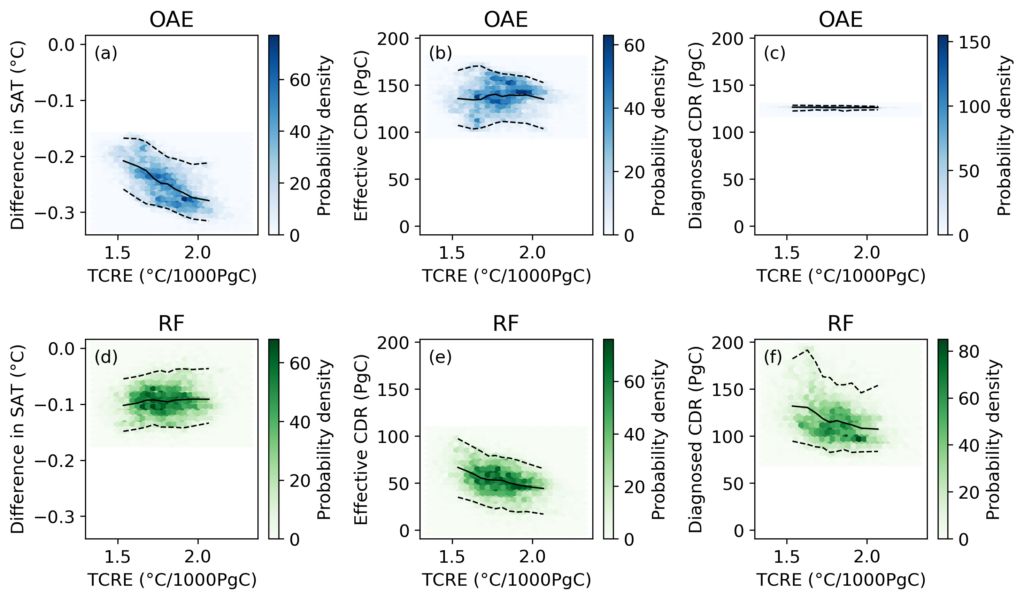
Figure caption: Relationship between transient climate response to cumulative CO2 emissions (TCRE) and the change in surface air temperature (SAT) (a), (d), cumulative effective CDR (b), (e), and cumulative CDR (c), (f) until 2300, for ocean alkalinity enhancement (OAE) and reforestation (RF) scenarios, respectively. The solid lines represent the mean values over 10000 realizations, and the dashed lines represent the 95% credible intervals.
Effective CDR: represents the net cooling effect of a CDR method due to both its biogeochemical and -physical effects.
CDR: does not include the biogeophysical effects on a CDR method, estimating the equivalent amount of CDR by direct air capture to get the same atmospheric CO2 response.
The results underline the importance of considering uncertainties in both climate sensitivity to cumulative CO2 emissions and CDR when planning climate mitigation policy. Notably, reforestation may become less effective precisely in scenarios where strong mitigation is most needed.
The research was part of the ACCC Flagship and conducted at the Finnish Meteorological Institute in 2023–2025 in collaboration with GEOMAR Helmholtz Centre for Ocean Research Kiel and NASA’s Jet Propulsion Laboratory. Read more…
Link to the publication: https://doi.org/10.1088/1748-9326/ae20a5